

What Specific Types Of Tissue Makeup Skin
Describe the layers of the pare and the functions of each layer
The skin is composed of 2 major layers: a superficial epidermis and a deeper dermis. The epidermis consists of several layers The topmost layer consists of dead cells that shed periodically and is progressively replaced by cells formed from the basal layer. The dermis connects the epidermis to the hypodermis, and provides strength and elasticity due to the presence of collagen and elastin fibers. The hypodermis, deep to the dermis of skin, is the connective tissue that connects the dermis to underlying structures; it too harbors adipose tissue for fat storage and protection.
Learning Objectives
- Describe the different layers of the skin
- Describe the epidermis and identify its different components
- Describe the dermis and identify its different layers
- Identify and draw the hypodermis and deep fascia
- Draw the role of melanocytes in peel pigmentation
Layers of the Peel
Although you may not typically think of the pare as an organ, information technology is in fact made of tissues that piece of work together as a single structure to perform unique and critical functions. The peel and its accessory structures make up the integumentary system, which provides the body with overall protection. The skin is made of multiple layers of cells and tissues, which are held to underlying structures past connective tissue (Effigy 1). The deeper layer of skin is well vascularized (has numerous blood vessels). It besides has numerous sensory, and autonomic and sympathetic nerve fibers ensuring communication to and from the brain.

Effigy 1. The skin is equanimous of two master layers: the epidermis, fabricated of closely packed epithelial cells, and the dermis, made of dense, irregular connective tissue that houses blood vessels, hair follicles, sweat glands, and other structures. Beneath the dermis lies the hypodermis, which is composed mainly of loose connective and fatty tissues.
The skin consists of two main layers and a closely associated layer. View this animation to learn more about layers of the skin. What are the bones functions of each of these layers?
Epidermis
The epidermis is composed of keratinized, stratified squamous epithelium. It is made of four or five layers of epithelial cells, depending on its location in the trunk. Information technology does not have any blood vessels inside it (i.due east., information technology is avascular). Skin that has four layers of cells is referred to as "sparse skin." From deep to superficial, these layers are the stratum basale, stratum spinosum, stratum granulosum, and stratum corneum. Almost of the skin can exist classified as sparse peel. "Thick pare" is establish only on the palms of the easily and the soles of the feet. It has a fifth layer, called the stratum lucidum, located between the stratum corneum and the stratum granulosum (Effigy 2).

Figure two. These slides show cross-sections of the epidermis and dermis of (a) thin and (b) thick pare. Note the significant difference in the thickness of the epithelial layer of the thick skin. From top, LM × 40, LM × 40. (Micrographs provided by the Regents of University of Michigan Medical School © 2012)
The cells in all of the layers except the stratum basale are called keratinocytes. A keratinocyte is a cell that manufactures and stores the protein keratin. Keratin is an intracellular gristly protein that gives pilus, nails, and skin their hardness and h2o-resistant backdrop. The keratinocytes in the stratum corneum are dead and regularly slough away, being replaced past cells from the deeper layers (Figure 3).

Figure 3. The epidermis is epithelium composed of multiple layers of cells. The basal layer consists of cuboidal cells, whereas the outer layers are squamous, keratinized cells, and then the whole epithelium is often described as being keratinized stratified squamous epithelium. LM × forty. (Micrograph provided past the Regents of University of Michigan Medical School © 2012)
View the University of Michigan WebScope to explore the tissue sample in greater detail. If you zoom on the cells at the outermost layer of this section of pare, what exercise you notice well-nigh the cells?
Practice Question
If yous zoom on the cells at the outermost layer of this section of skin (Figure 3), what practise you lot notice virtually the cells?
Show Answer
These cells practice not accept nuclei, then y'all can deduce that they are dead. They appear to be sloughing off.
Stratum Basale
The stratum basale (too called the stratum germinativum) is the deepest epidermal layer and attaches the epidermis to the basal lamina, below which lie the layers of the dermis. The cells in the stratum basale bond to the dermis via intertwining collagen fibers, referred to every bit the basement membrane. A finger-like project, or fold, known as the dermal papilla (plural = dermal papillae) is found in the superficial portion of the dermis. Dermal papillae increase the forcefulness of the connection between the epidermis and dermis; the greater the folding, the stronger the connections made (Figure 4).
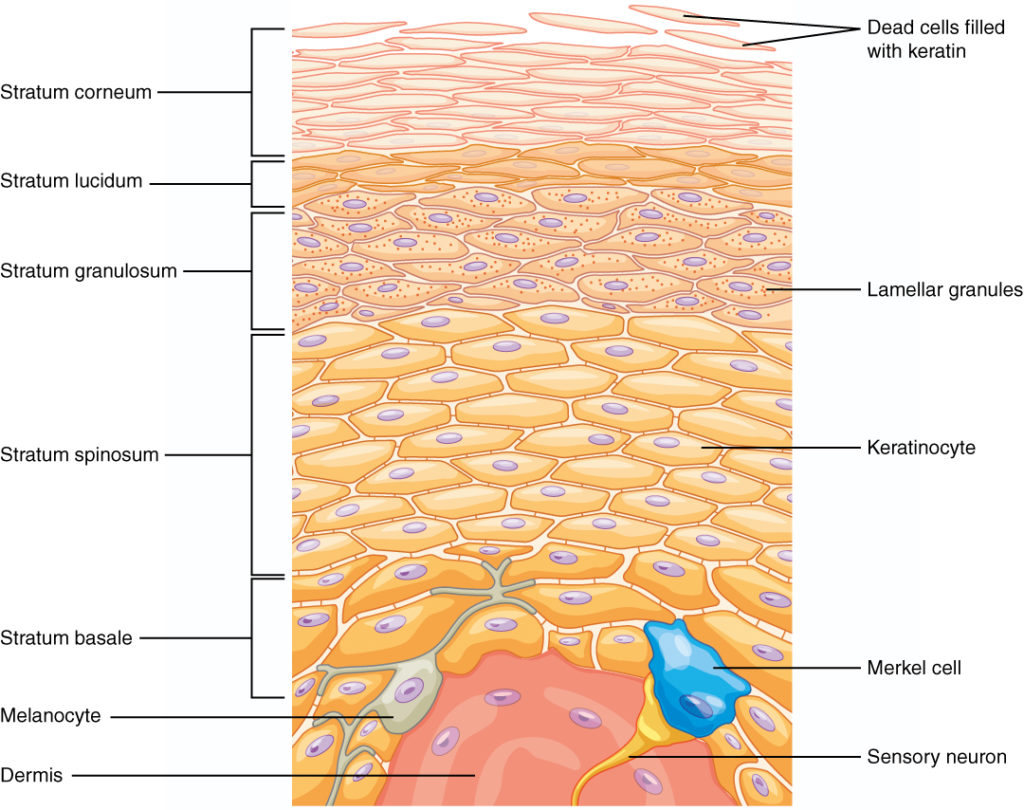
Effigy four. The epidermis of thick pare has 5 layers: stratum basale, stratum spinosum, stratum granulosum, stratum lucidum, and stratum corneum.
The stratum basale is a single layer of cells primarily made of basal cells. A basal jail cell is a cuboidal-shaped stem cell that is a precursor of the keratinocytes of the epidermis. All of the keratinocytes are produced from this single layer of cells, which are constantly going through mitosis to produce new cells. As new cells are formed, the existing cells are pushed superficially away from the stratum basale. Two other cell types are found dispersed among the basal cells in the stratum basale. The beginning is a Merkel prison cell, which functions as a receptor and is responsible for stimulating sensory nerves that the brain perceives every bit touch. These cells are especially arable on the surfaces of the hands and feet. The second is a melanocyte, a cell that produces the paint melanin. Melanin gives hair and peel its colour, and also helps protect the living cells of the epidermis from ultraviolet (UV) radiation impairment.
In a growing fetus, fingerprints grade where the cells of the stratum basale meet the papillae of the underlying dermal layer (papillary layer), resulting in the formation of the ridges on your fingers that you recognize as fingerprints. Fingerprints are unique to each individual and are used for forensic analyses because the patterns do not change with the growth and crumbling processes.
Stratum Spinosum
As the name suggests, the stratum spinosum is spiny in appearance due to the protruding prison cell processes that join the cells via a construction chosen a desmosome. The desmosomes interlock with each other and strengthen the bond between the cells. It is interesting to annotation that the "spiny" nature of this layer is an artifact of the staining process. Unstained epidermis samples do non exhibit this characteristic appearance. The stratum spinosum is composed of eight to ten layers of keratinocytes, formed as a effect of prison cell division in the stratum basale (Effigy 5). Interspersed amidst the keratinocytes of this layer is a type of dendritic cell called the Langerhans prison cell, which functions as a macrophage past engulfing bacteria, strange particles, and damaged cells that occur in this layer.
Practice Question
Cells of the epidermis derive from stalk cells of the stratum basale. Describe how the cells change as they become integrated into the different layers of the epidermis.
Show Answer
As the cells motion into the stratum spinosum, they begin the synthesis of keratin and extend cell processes, desmosomes, which link the cells. Every bit the stratum basale continues to produce new cells, the keratinocytes of the stratum spinosum are pushed into the stratum granulosum. The cells go flatter, their jail cell membranes thicken, and they generate big amounts of the proteins keratin and keratohyalin. The nuclei and other jail cell organelles disintegrate as the cells die, leaving backside the keratin, keratohyalin, and cell membranes that grade the stratum lucidum and the stratum corneum. The keratinocytes in these layers are mostly dead and flattened. Cells in the stratum corneum are periodically shed.

Figure 5. The cells in the different layers of the epidermis originate from basal cells located in the stratum basale, all the same the cells of each layer are distinctively dissimilar. EM × 2700. (Micrograph provided by the Regents of Academy of Michigan Medical Schoolhouse © 2012)
View the University of Michigan WebScope to explore the tissue sample in greater detail. If yous zoom on the cells at the outermost layer of this section of skin, what do you notice about the cells?
Do Question
If you zoom on the cells of the stratum spinosum (Figure 5), what is distinctive near them?
Show Answer
These cells have desmosomes, which requite the cells their spiny appearance.
The keratinocytes in the stratum spinosum begin the synthesis of keratin and release a water-repelling glycolipid that helps forbid water loss from the body, making the skin relatively waterproof. Every bit new keratinocytes are produced atop the stratum basale, the keratinocytes of the stratum spinosum are pushed into the stratum granulosum.
Stratum Granulosum
The stratum granulosum has a grainy appearance due to further changes to the keratinocytes equally they are pushed from the stratum spinosum. The cells (three to five layers deep) become flatter, their cell membranes thicken, and they generate big amounts of the proteins keratin, which is fibrous, and keratohyalin, which accumulates as lamellar granules within the cells (see Figure iv). These two proteins make up the bulk of the keratinocyte mass in the stratum granulosum and give the layer its grainy advent. The nuclei and other cell organelles atomize every bit the cells die, leaving behind the keratin, keratohyalin, and cell membranes that will course the stratum lucidum, the stratum corneum, and the accompaniment structures of hair and nails.
Stratum Lucidum
The stratum lucidum is a smoothen, seemingly translucent layer of the epidermis located just higher up the stratum granulosum and below the stratum corneum. This thin layer of cells is establish simply in the thick peel of the palms, soles, and digits. The keratinocytes that compose the stratum lucidum are expressionless and flattened (run into Figure 4). These cells are densely packed with eleiden, a clear poly peptide rich in lipids, derived from keratohyalin, which gives these cells their transparent (i.e., lucid) advent and provides a bulwark to water.
Stratum Corneum
The stratum corneum is the about superficial layer of the epidermis and is the layer exposed to the exterior environment (meet Figure 4). The increased keratinization (also called cornification) of the cells in this layer gives it its proper noun. There are usually fifteen to xxx layers of cells in the stratum corneum. This dry out, expressionless layer helps prevent the penetration of microbes and the dehydration of underlying tissues, and provides a mechanical protection against abrasion for the more delicate, underlying layers. Cells in this layer are shed periodically and are replaced past cells pushed upwards from the stratum granulosum (or stratum lucidum in the case of the palms and soles of feet). The unabridged layer is replaced during a period of most 4 weeks. Cosmetic procedures, such as microdermabrasion, help remove some of the dry out, upper layer and aim to continue the skin looking "fresh" and healthy.
Dermis

Figure vi. This stained slide shows the two components of the dermis—the papillary layer and the reticular layer. Both are made of connective tissue with fibers of collagen extending from one to the other, making the border between the two somewhat indistinct. The dermal papillae extending into the epidermis belong to the papillary layer, whereas the dense collagen fiber bundles below belong to the reticular layer. LM × x. (credit: modification of work by "kilbad"/Wikimedia Commons)
The dermis might be considered the "core" of the integumentary organization (derma- = "pare"), every bit singled-out from the epidermis (epi– = "upon" or "over") and hypodermis (hypo– = "below"). It contains blood and lymph vessels, nerves, and other structures, such equally hair follicles and sweat glands. The dermis is made of ii layers of connective tissue that compose an interconnected mesh of elastin and collagenous fibers, produced past fibroblasts (Figure 6).
Papillary Layer
The papillary layer is made of loose, areolar connective tissue, which means the collagen and elastin fibers of this layer form a loose mesh. This superficial layer of the dermis projects into the stratum basale of the epidermis to form finger-like dermal papillae (meet Figure 6). Within the papillary layer are fibroblasts, a small number of fat cells (adipocytes), and an affluence of small blood vessels. In add-on, the papillary layer contains phagocytes, defensive cells that assistance fight bacteria or other infections that have breached the skin. This layer also contains lymphatic capillaries, nerve fibers, and touch receptors chosen the Meissner corpuscles.
Reticular Layer
Underlying the papillary layer is the much thicker reticular layer, equanimous of dumbo, irregular connective tissue. This layer is well vascularized and has a rich sensory and sympathetic nerve supply. The reticular layer appears reticulated (net-like) due to a tight meshwork of fibers. Elastin fibers provide some elasticity to the pare, enabling motility. Collagen fibers provide structure and tensile strength, with strands of collagen extending into both the papillary layer and the hypodermis. In addition, collagen binds water to go on the pare hydrated. Collagen injections and Retin-A creams help restore skin turgor by either introducing collagen externally or stimulating blood flow and repair of the dermis, respectively.
Hypodermis
The hypodermis (too called the subcutaneous layer or superficial fascia) is a layer directly below the dermis and serves to connect the skin to the underlying fascia (fibrous tissue) of the bones and muscles. It is not strictly a part of the peel, although the border between the hypodermis and dermis can be difficult to distinguish. The hypodermis consists of well-vascularized, loose, areolar connective tissue and adipose tissue, which functions as a mode of fat storage and provides insulation and cushioning for the integument.
Lipid Storage
The hypodermis is home to most of the fat that concerns people when they are trying to keep their weight under control. Adipose tissue present in the hypodermis consists of fatty-storing cells called adipocytes. This stored fat tin serve as an energy reserve, insulate the body to prevent rut loss, and act equally a cushion to protect underlying structures from trauma.
Where the fat is deposited and accumulates inside the hypodermis depends on hormones (testosterone, estrogen, insulin, glucagon, leptin, and others), as well as genetic factors. Fat distribution changes as our bodies mature and historic period. Men tend to accrue fat in different areas (neck, arms, lower back, and abdomen) than do women (breasts, hips, thighs, and buttocks). The trunk mass index (BMI) is oftentimes used as a measure of fat, although this measure out is, in fact, derived from a mathematical formula that compares trunk weight (mass) to height. Therefore, its accuracy equally a health indicator can exist chosen into question in individuals who are extremely physically fit.
In many animals, at that place is a blueprint of storing excess calories as fat to be used in times when nutrient is not readily available. In much of the developed world, insufficient exercise coupled with the gear up availability and consumption of high-calorie foods have resulted in unwanted accumulations of adipose tissue in many people. Although periodic aggregating of backlog fat may have provided an evolutionary reward to our ancestors, who experienced unpredictable bouts of famine, information technology is now becoming chronic and considered a major health threat. Contempo studies indicate that a lamentable percentage of our population is overweight and/or clinically obese. Not only is this a trouble for the individuals affected, but it likewise has a severe impact on our healthcare system. Changes in lifestyle, specifically in diet and exercise, are the best ways to command torso fat aggregating, especially when it reaches levels that increment the risk of middle disease and diabetes.
Pigmentation
The color of skin is influenced past a number of pigments, including melanin, carotene, and hemoglobin. Recall that melanin is produced past cells called melanocytes, which are found scattered throughout the stratum basale of the epidermis. The melanin is transferred into the keratinocytes via a cellular vesicle chosen a melanosome (Figure seven).

Effigy vii. The relative coloration of the skin depends of the amount of melanin produced by melanocytes in the stratum basale and taken upward by keratinocytes.
Melanin occurs in two primary forms. Eumelanin, the well-nigh common form of melanin, exists as black and brown, whereas pheomelanin provides a red colour. Dark-skinned individuals produce more melanin than those with pale pare. Exposure to the UV rays of the sun or a tanning salon causes melanin to be manufactured and built up in keratinocytes, equally sun exposure stimulates keratinocytes to secrete chemicals that stimulate melanocytes. The accumulation of melanin in keratinocytes results in the concealment of the peel, or a tan. This increased melanin accumulation protects the DNA of epidermal cells from UV ray damage and the breakdown of folic acrid, a nutrient necessary for our wellness and well-being. In dissimilarity, besides much melanin can interfere with the production of vitamin D, an important nutrient involved in calcium absorption. Thus, the amount of melanin nowadays in our peel is dependent on a balance betwixt available sunlight and folic acrid devastation, and protection from UV radiation and vitamin D production.
It requires about 10 days later on initial sun exposure for melanin synthesis to peak, which is why stake-skinned individuals tend to suffer sunburns of the epidermis initially. Dark-skinned individuals tin can as well become sunburns, only are more protected than are pale-skinned individuals. Melanosomes are temporary structures that are eventually destroyed by fusion with lysosomes; this fact, along with melanin-filled keratinocytes in the stratum corneum sloughing off, makes tanning impermanent.
Too much lord's day exposure tin can somewhen pb to wrinkling due to the destruction of the cellular construction of the skin, and in severe cases, can crusade sufficient Dna harm to result in skin cancer. When there is an irregular aggregating of melanocytes in the peel, freckles appear. Moles are larger masses of melanocytes, and although most are beneficial, they should be monitored for changes that might betoken the presence of cancer (Figure 8).

Figure eight. Moles range from benign accumulations of melanocytes to melanomas. These structures populate the landscape of our skin. (credit: the National Cancer Institute)
Practice Question
What determines the color of skin, and what is the process that darkens pare when it is exposed to UV light?
Show Answer
The pigment melanin, produced past melanocytes, is primarily responsible for peel color. Melanin comes in different shades of brown and black. Individuals with darker peel have darker, more than arable melanin, whereas fair-skinned individuals have a lighter shade of skin and less melanin. Exposure to UV irradiation stimulates the melanocytes to produce and secrete more melanin.
Integumentary Arrangement
The first matter a clinician sees is the skin, and then the examination of the skin should be part of any thorough concrete test. Most skin disorders are relatively beneficial, just a few, including melanomas, tin can be fatal if untreated. A couple of the more than noticeable disorders, albinism and vitiligo, touch the appearance of the pare and its accessory organs. Although neither is fatal, it would exist hard to merits that they are benign, at least to the individuals so afflicted.

Figure nine. Individuals with vitiligo feel depigmentation that results in lighter colored patches of peel. The condition is specially noticeable on darker skin. (credit: Klaus D. Peter)
Albinism is a genetic disorder that affects (completely or partially) the coloring of skin, pilus, and eyes. The defect is primarily due to the inability of melanocytes to produce melanin. Individuals with albinism tend to appear white or very pale due to the lack of melanin in their peel and hair. Recall that melanin helps protect the skin from the harmful effects of UV radiations. Individuals with albinism tend to need more protection from UV radiation, as they are more prone to sunburns and skin cancer. They also tend to be more than sensitive to light and take vision problems due to the lack of pigmentation on the retinal wall. Handling of this disorder usually involves addressing the symptoms, such every bit limiting UV light exposure to the skin and eyes. In vitiligo, the melanocytes in certain areas lose their power to produce melanin, possibly due to an autoimmune reaction. This leads to a loss of color in patches (Figure ix). Neither albinism nor vitiligo direct affects the lifespan of an private.
Other changes in the appearance of skin coloration can exist indicative of diseases associated with other trunk systems. Liver illness or liver cancer tin crusade the accumulation of bile and the yellow pigment bilirubin, leading to the skin actualization yellow or jaundiced (jaune is the French discussion for "yellow"). Tumors of the pituitary gland can event in the secretion of big amounts of melanocyte-stimulating hormone (MSH), which results in a concealment of the skin. Similarly, Addison'southward disease can stimulate the release of excess amounts of adrenocorticotropic hormone (ACTH), which can give the skin a deep statuary colour. A sudden drop in oxygenation tin can affect peel color, causing the skin to initially turn ashen (white). With a prolonged reduction in oxygen levels, dark ruby-red deoxyhemoglobin becomes ascendant in the blood, making the peel appear blue, a condition referred to as cyanosis (kyanos is the Greek word for "blueish"). This happens when the oxygen supply is restricted, as when someone is experiencing difficulty in breathing because of asthma or a heart assail. Notwithstanding, in these cases the effect on skin color has nothing do with the skin's pigmentation.
Check Your Understanding
Answer the question(southward) below to see how well you understand the topics covered in the previous section. This brusk quiz doesnon count toward your form in the class, and you can retake it an unlimited number of times.
Use this quiz to bank check your understanding and decide whether to (1) written report the previous section further or (ii) move on to the next section.
Source: https://courses.lumenlearning.com/suny-wmopen-biology2/chapter/structure-and-function-of-skin/
Posted by: jacobsfure1940.blogspot.com
0 Response to "What Specific Types Of Tissue Makeup Skin"
Post a Comment